I had the opportunity to participate with the Keio Robotics Grant Prix tournament. At first we were unsure if our long time JA was going to make it back from America to Japan in time, but luckily he did. During the time of uncertainty I was preparing to take over his role as JA by checking with the event partner and letting them know all of the rule changes from last year. We attempted to get more judges signed up but we ended up with only four. This meant for 36 teams we were going to have a really tight schedule on event day.
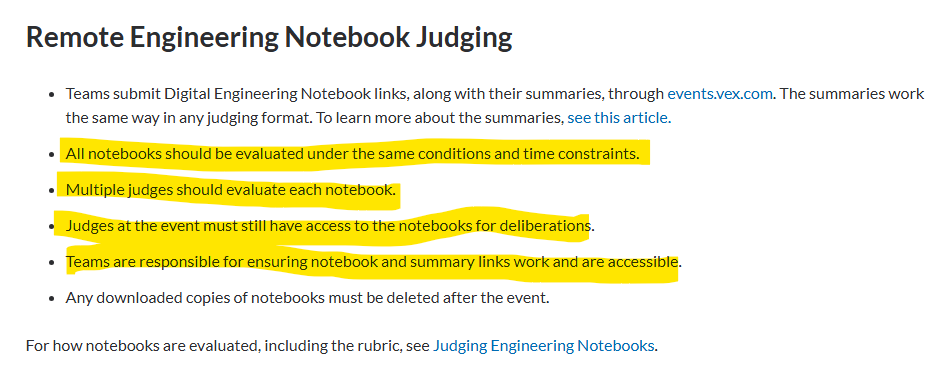
We took the 20 submitted notebooks and judged them over 3 days prior to the event and the morning of the event before the driver meeting. Yes, several of the notebooks are larger than others and if they did not provide a summary page or a ToC, difficulty was inevitable, but we knew it in advance. On average, it was about 15 to 20 minutes per notebook with a couple taking about 40 + minutes. I was asked by the event partner to skim through them to speed up the process, but I refused and explained that I cannot gather qualitative nor quantitative data reliably if I only skim.
When we started, we had two new judges among the four of us, so we split the experienced judges with the new ones. One of them also chose to get the JA cert as well, which was beneficial to our preparation before going to the pit area. We took about 40 minutes to introduce ourselves, go over the new expectations, and select a few opening questions.
We made it a point to:
- both focus on what the team members are telling us
- ask follow up questions that require specific knowledge as a response
- point to specific areas of code or parts of the robot to have the students explain more about that part/section, and where they got the idea or training for that area (mostly YouTube, a few from previous years exp.)
- We also let them know in advance that we have already reviewed their notebooks in detail and we have some specific questions to ask. This was helpful for the students to really let their knowledge shine, and not just read a book entry. It was helpful also to see what team members were truly involved and not just told to read a section.
- if we needed to reflect upon a specific part of the notebook we asked them to open it up and explain more about it.
- we are also watching for member involvement in conversation, paying attention to the interview, helping each other to explain or show parts of the robot, etc.
- when finished we thanked them for their time and wished them good luck, then left the pit area and went to a private area with no people around to quickly discuss the interview and write down the detailed points needed for the rubric, then returned to the field right away. This took about 1 to 3 minutes each time and was very efficient because, even though we both were not taking any notes, we both were focused on the students and that clarity followed by immediate out-of-pit discussion facilitated easy recall of the interview.
18 teams to judge for each judging pair is 180 minutes (3 H) of time for the interview and 5 minutes (1.5 H) of off-site discussion.
Driver meeting was at 9:45 am, and after that we started. Luckily, we finished before 2:00 pm and started our review and deliberations.
All in all, the event was fantastic, even though it was back to back interviewing this time (no time to watch them practice or compete).
Great experience, and I am very glad we did the notebooks 3 days earlier.
To facilitate the interview process for the future, I will work with the event partner and JAs to have interview rooms set up and the students need to queue up to our room just like they do for matches or skills. This will eliminate a lot of the trouble of trying to find a team to interview in the pit or practice areas. That should speed up the process.
Lets see.